Image
hesd cluster
SDGs associated
Read the latest report on SDGs activities carried out by the IAU HESD Cluster members

Discover the latest report on SDGs activities carried out by the IAU HESD Cluster members:
 

2024-25 Activity Report: https://iau-hesd.net/sites/default/files/media_files/IAUHESDClusterReportActivities2024_5.pdf 
 

What is the HESD cluster?
 

Unlike other projects in this area, the IAU Global Cluster on HESD brings HEIs from all continents together, and encourages them to develop joint initiatives and synergies. This project is about bringing together universities to exchange and work on an equal footing.

The Cluster works on all dimensions of the SDGs, combining economic, social, cultural, and environmental sustainability. Especially the cultural dimension of SD will be at the core of this Cluster, since this is an area not touched-upon a lot by others. Yet, due to the diverse nature of the IAU, the association believes that this is the key to successful partnerships and a holistic understanding of the Global Goals.

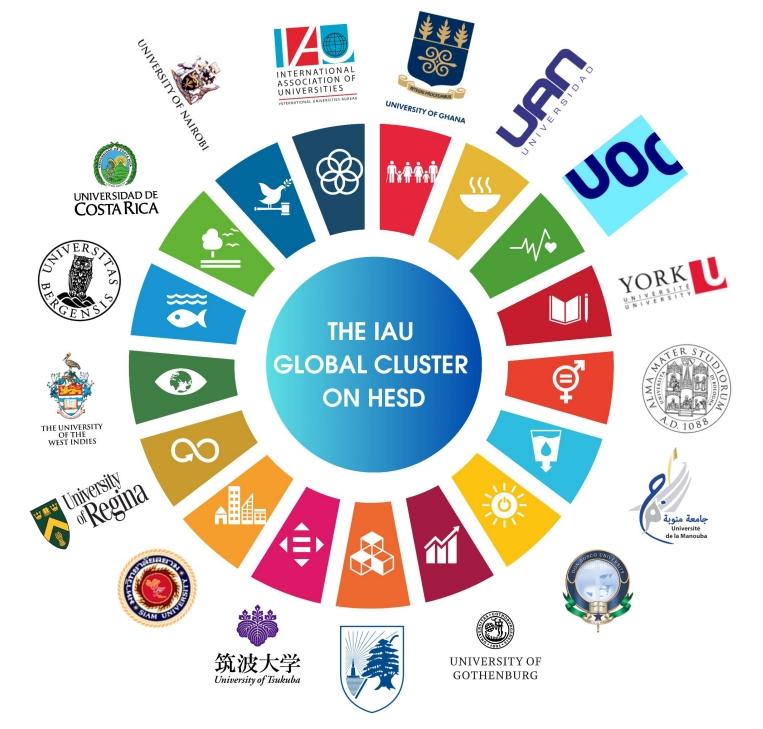
The Cluster is composed of 16 lead Institutions, each championing and working on one specific SDG while at the same time linking it to other relevant SDGs. Work on goal 17, which consists of multiple organizations working together, is led by IAU. Gradually, additional institutions will be invited on board. The Cluster will be supported, monitored and steered by the IAU Working Group on HESD. Initiatives developed by the Cluster will be made available to all IAU Members.

Read more about the Cluster here: https://www.iau-hesd.net/index.php/IAU-Global-HESD-Cluster  

Latest update: 28.07.2025
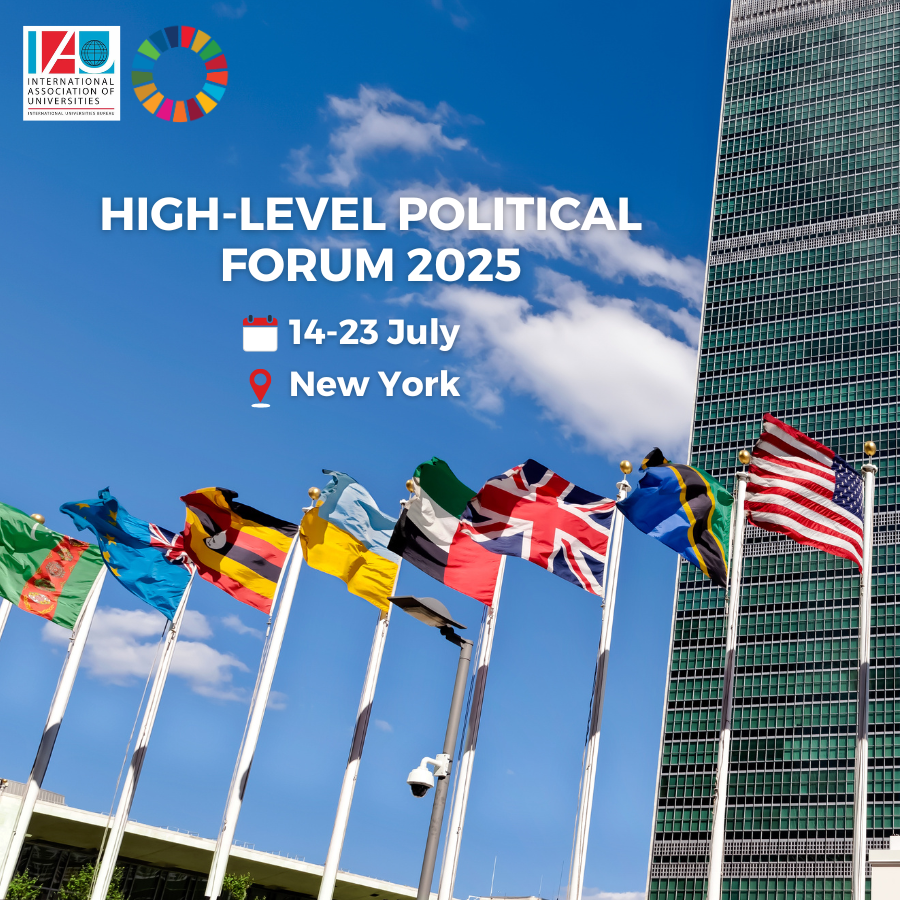
The IAU participated in the High-Level Political Forum 2025 to advocate for the role of higher education in achieving the SDGs. IAU contributed to several key events, including the UNAI Higher Education Symposium, the HESI Global Forum, and a side event focused on SDG 8.

The High-Level Political Forum 2025 (HLPF) convened under the theme: “Advancing sustainable, inclusive, science- and evidence-based solutions for the 2030 Agenda for Sustainable Development and its SDGs for leaving no one behind.”

This year’s Forum reviewed five interconnected goals:

  • SDG 3 – Good Health and Well-being

  • SDG 5 – Gender Equality

  • SDG 8 – Decent Work and Economic Growth

  • SDG 14 – Life Below Water

  • SDG 17 – Partnerships for the Goals

The Forum welcomed high-level representatives from governments, UN bodies, academia, civil society, and the private sector. In addition to the ministerial segment (21–23 July), the programme included:

  • Voluntary National Reviews (VNRs) showcasing country-level progress

  • Side events, special sessions, VNR Labs, and exhibitions exploring practical, interdisciplinary, and collaborative pathways to sustainability

As an organisation holding ECOSOC consultative status, the International Association of Universities (IAU) actively contributes to this important annual UN platform. We are pleased to announce that IAU participated in the 2025 HLPF with a small delegation, led by the IAU Secretary General, and including representatives from the University of Gothenburg and institutional partners. Together, we aim to highlight the critical role of higher education in advancing the SDGs, now and beyond 2030.

IAU Report at the HLPF 2025

Read about IAU's involvement at the HLPF 2025 in the Report here.

Read more in University World News here.

IAU and partners were involved in the following events during HLPF 2025:

  • Science Day on Tuesday, 15 July, organised by the International Science Council (onsite/online). More information here.

  • Event hosted by the Education and Academia Stakeholder Group  
    Wednesday, 16 July (on site, for HLPF participants)

  • HLPF Side Event: Solving Real-World Water Challenges through Empowering Youth Innovation
    18 July, 09:30 AM - 12:00 PM Eastern time
    Co-organizers: PRME Students, HESI Student Action Group, UNESCO IESALC
    Location: PRME, UN Global Compact Office, 685 Third Avenue, 12th Floor & hybrid-online.

    This session explores how students and young people can become active problem-solvers in tackling real-world water issues — from urban flooding and biodiversity loss to water equity and pollution. Grounded in the of SDG 6 (Clean Water & Sanitation), SDG 8 (Decent Work & Economic Growth), and SDG 14 (Life Below Water), it brings together higher education, corporate professionals, and youth to co-develop pathways that link sustainability education with innovation, community impact, and green careers.

    More information here.

  • Global Higher Education Symposium
    18 July 2025, 1:00 PM to 6:00 PM EDT New York, USA (Invitation Only)
    Partners: United Nations Academic Impact (UNAI), UNESCO, ISC, International Association of Universities (IAU), SDSN, German Center for Research, York University

    Alongside HLPF, this Symposium aims to address the critical role and potential of, as well as trust in, higher education institutions (HEIs). As globally networked actors in advancing livable futures across the globe, HEIs must aim to critically engage with current frameworks, such as the SDGs, as well as a post-2030 development agenda.


  • HESI Global Forum 2025
    Breaking Barriers in Sustainable Development Through Scientific, Inclusive and Equitable Solutions
    21 July, 07:00 AM - 09:30 AM EST NYC time (virtual)

    Each year, HESI organizes a global forum as a special event for the High-level Political Forum on Sustainable Development (HLPF) – UN’s main platform for the follow-up and review of the 2030 Agenda for Sustainable Development at the global level - to highlight the critical role of higher education in achieving sustainable development.
    HESI website: https://sdgs.un.org/HESI


  • Side Event: Accelerating SDG 8 implementation: How academia can support policies and partnerships that provide decent work for all and sustainable economic growth
    22 July, 1:15 p.m. - 2:30 p.m. NYC time (on site, UN HQ, room F)

    Partners: University College Dublin (UCD), United Nations Academic Impact (UNAI) SDG Hub 8, International Labour Organization (ILO), International Association of Universities (IAU), UN Sustainable Development Solutions Network (SDSN) – the SDG Academy, University of Gothenburg, University of Auckland, University of Nigeria Nsukka, Makerere University, University of Economics Ho Chi Minh City.
    Member State partners: Nigeria, Kenya, Uganda

    Academia is uniquely positioned to be a driver of sustainable development through research, innovation, education, and collaboration. In support of SDG 8 Decent Work and Economic Growth, universities have the opportunity and responsibility to shape an inclusive, equitable and resilient future.

    Learn more here: https://www.gu.se/en/news/university-of-gothenburg-and-partners-host-side-event-on-sdg-8-at-the-un-high-level-political-forum 


  • Teaching the Change: Inclusive, Evidence-Based Learning for the SDGs
    22 July 1:00 PM - 2:20 PM GMT+2 (online)
    Organised by Sulitest & PRME

    In a rapidly shifting world shaped by misinformation, eco-anxiety, technological disruption, and polarized politics, education systems are at a critical crossroads. This side event, organized by Sulitest and Principles for Responsible Management Education (PRME), explores how science-based, inclusive, and transformative education can support the 2030 Agenda and ensure all students develop sustainability literacy–knowledge, skills and mindset.

    The event will open with a data-driven exploration of current trends in sustainability education, and discuss evidence- and science-based education: How do we empower students to think critically, navigate misinformation, and manage eco-anxiety? Next to a focus on Inclusive pedagogy: How can education elevate diverse voices and cultivate self-awareness, empathy, and collaboration competencies?

    Learn more and register here.

Please note that this list might be updated with changes and other events over the next few weeks. The information is intended for higher education representatives at the HLPF or wishing to engage online, and is provided without guarantee of correctness. 

The new IAU HESD Cluster Report 2024–2025 will also be shared publicly at the HLPF. The report showcases concrete contributions and collaborations from various higher education institutions toward all 17 SDGs.

As the 2030 deadline approaches, the HLPF remains a central space for reinforcing accountability, fostering innovation, and ensuring no one is left behind.

Click here for more information.

Latest update: 17.04.2026
Image
RFI Pilot
SDGs associated
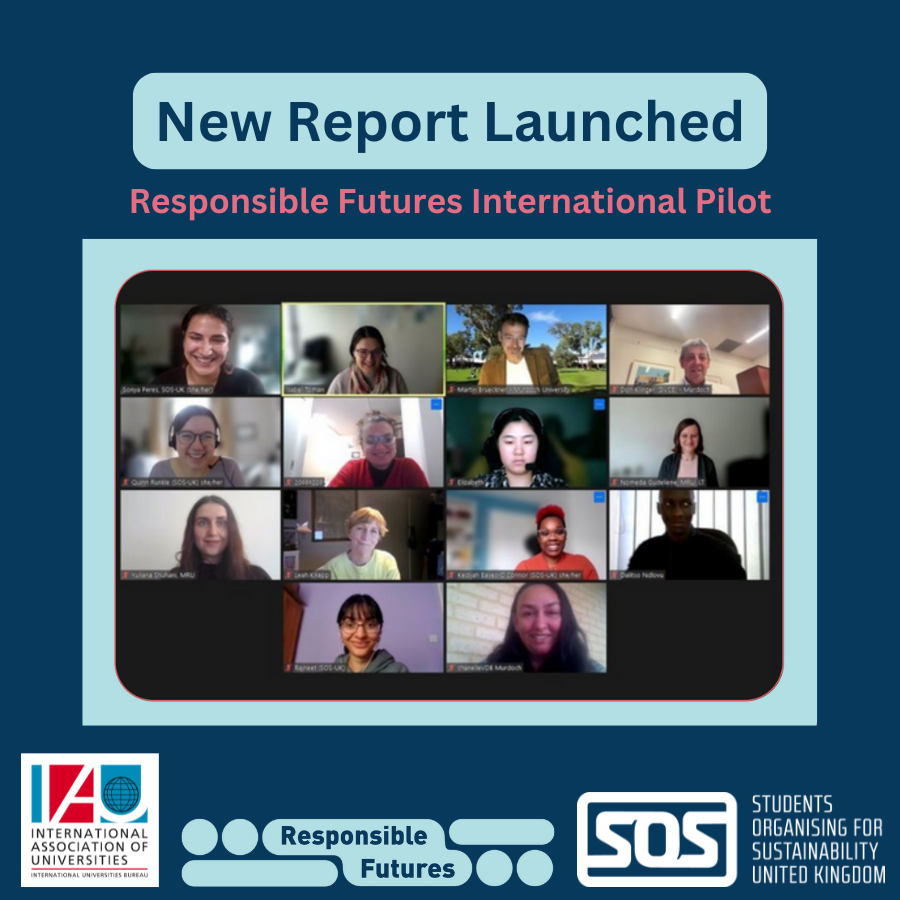
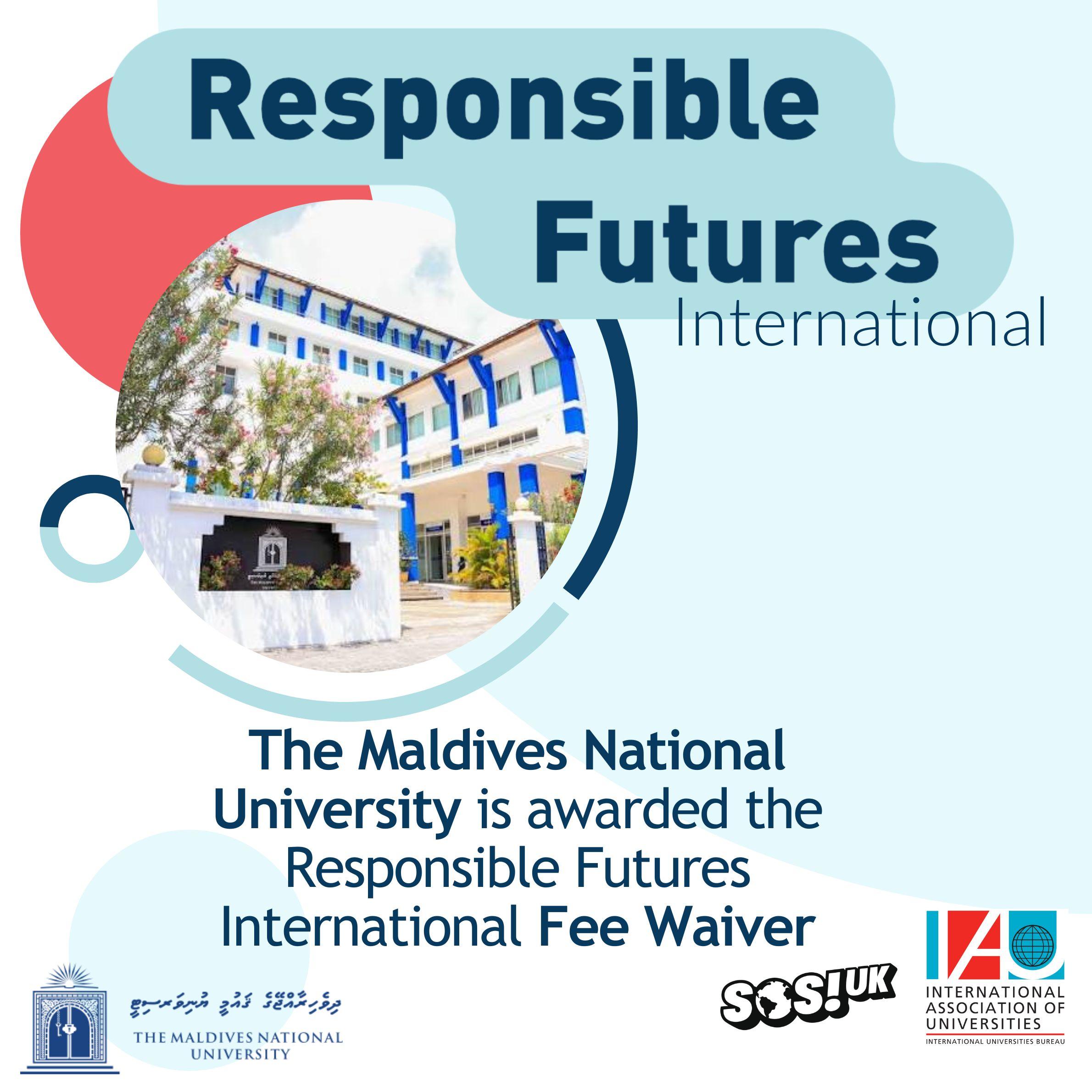
The IAU and SOS-UK have launched the Responsible Futures International Pilot Report, highlighting key impacts, outcomes, and lessons from the 2023/24 programme involving institutions across six countries.

In collaboration with Students Organising for Sustainability (SOS-UK), we are proud to announce the launch of the Responsible Futures International Pilot Report.

This report captures the key impacts, outcomes, and lessons from the 2023/24 pilot programme, which engaged six universities and one college across six countries. Each institution played a leadership role in shaping and testing a global framework for Education for Sustainable Development (ESD), working closely with students to embed sustainability in learning and practice.

We extend our heartfelt thanks to all participating institutions for your dedication and leadership. Your contributions are helping to develop an international approach to sustainability in higher education that can support universities and colleges worldwide.

Access the full report here: https://www.responsiblefutures.org.uk/resources/responsible-futures-international-2024-pilot-report  

Latest update: 17.06.2025

We're thrilled to announce the finalists of the 2026 International Green Gown Awards, delivered by EAUC.

The International Green Gown Awards are endorsed by United Nations Environment Programme and are supported by the Association of Commonwealth Universities (ACU), L’Agence universitaire de la Francophonie (AUF) and International Association of Universities (IAU). Now in their 12th year, the Awards recognise the outstanding and innovative sustainability projects being implemented in tertiary education institutions around the world. 

This year, we have 94 finalists from 34 countries and 63 institutions across eight categories, and we are pleased to see that once again several IAU Members are amongst the finalists!

Finalists that are IAU Members sorted after category:

2030 Climate Action

  • Laval University
  • University Mohammed VI Polytechnic
  • Tashkent State University of Law

Benefitting Society

  • Pontifical Catholic University of Peru
  • Siam University

Creating impact

  • Daffodil International University
  • Siam University
  • Technological University Dublin

Diversity, Equity and Inclusion in Sustainability

  • De La Salle Lipa
  • University Mohammed VI Polytechnic
  • Tashkent State University of Law

Nature Positive

  • University Mohammed VI Polytechnic

Next Generation Learning and Skills

  • De La Salle Lipa
  • Daffodil International University
  • University Mohammed VI Polytechnic
  • Siam University

Student Engagement

  • University Mohammed VI Polytechnic
  • International Islamic University Malaysia
  • Siam University

Sustainability Institution of the Year

  • University Mohammed VI Polytechnic

-> Learn more about the awards and read about the finalists and their projects on the Green Gown Awards website.

Latest update: 04.06.2026
Image
EASG sectoral paper
SDGs associated
Category
Universities associated
The EASG has launched its sectoral paper for the 2026 UN High-Level Political Forum (HLPF)

The Education and Academia Stakeholder Group (EASG) has launched its sectoral paper for the 2026 UN High-Level Political Forum (HLPF), presenting a global perspective on the role of education in advancing sustainable development. Developed through contributions from international education networks, civil society organisations, student representatives, and academic institutions, the paper highlights the interconnectedness of SDG 4 with other priority goals, including clean water and sanitation, clean energy, sustainable cities, innovation, and global partnerships.

The report examines persistent global challenges such as unequal access to quality education, underfunded education systems, digital divides, inadequate school infrastructure, and barriers faced by marginalised communities. It also outlines recommendations for governments and international stakeholders, including stronger public investment in education, climate-resilient and inclusive learning environments, ethical approaches to digital transformation and AI, and greater participation of youth and civil society in education governance.

IAU and several Members and partners provided input for the paper.

Explore the Sectoral paper here

Latest update: 27.05.2026
The IAU HESD Global Cluster Expert Meeting 2026, on the theme ''Building Global Partnerships for Sustainable Development'', brought together 40 higher education leaders, experts, and IAU Cluster members from around the world to advance the role of universities in achieving the Sustainable Development Goals (SDGs).

The IAU HESD Global Cluster Expert Meeting 2026, on the theme ''Building Global Partnerships for Sustainable Development'', brought together 40 higher education leaders, experts, and IAU Cluster members from around the world to advance the role of universities in achieving the Sustainable Development Goals (SDGs). The meeting was hosted in Carthage,Tunisia, in partnership with University of Carthage, University of Manouba, and University of Sousse. Over two days, participants engaged in a dynamic programme designed to foster collaboration, share knowledge, and co-create future strategies.

Day 1 featured an opening session, two panel discussions, and interactive world-café style group work sessions. These exchanges highlighted the need for universities to act as catalysts for sustainable, inclusive, and resilient societies through partnerships, innovation, and institutional transformation. The opening session highlighted the urgency of collective action as institutions work toward the 2030 Agenda and prepare for the challenges beyond. Speakers emphasized that universities must go beyond their traditional roles of teaching and research to become active drivers of societal transformation. Through global partnerships, innovation, and institutional change, higher education can help build more inclusive, resilient, and sustainable societies. Collaboration, particularly aligned with SDG17, was identified as a key enabler for progress across all goals.

Day 2 focused on a collaborative work session to develop a common Cluster action plan, followed by a workshop on the whole-institution approach to Education for Sustainable Development (ESD).

The workshop aimed to take stock of the IAU Global Cluster’s progress in 2026, share promising practices for integrating SDGs across university functions, and strengthen members’ capacity for effective sustainability action. Participants also contributed to shaping positions for the 2027 UN SDG 4 review and explored higher education’s role in a post-2030 agenda, in alignment with UNESCO’s new World Higher Education Roadmap. 

Key outcomes include the development of a joint action plan for the IAU HESD Clusters, and using the discussions from the workshop as foundation, a position paper will be drafted to inform the 2026 UN HLPF, the World Conference on ESD in early 2027, and the 2027 SDG 4 review. As a whole, the meeting facilitated strengthened partnerships, and enhanced visibility and alignment of collective efforts toward the 2030 Agenda.

More information about the meeting can be found here

Latest update: 28.04.2026
The International Association of Universities (IAU) is pleased to announce the launch of the 4th Global Survey on Higher Education and Research for Sustainable Development (HESD).

The IAU is pleased to announce the launch of the 4th Global Survey on Higher Education and Sustainable Development (HESD). This survey aligns with the IAU’s commitment to advance sustainability in higher education (HE) across the world and to forward the HE sector’s contribution to a more sustainable future. To ensure wide participation, the survey deadline to respond has been extended to 31 May 2026.

Conducted every four years under the IAU’s strategic priority on Higher Education and Research for Sustainable Development (HESD), the Global Survey is a keystone in providing insight into how higher education institutions (HEIs) integrate sustainable development into teaching, research, governance, and community engagement. This 4th edition will further investigate how sustainability is integrated into higher education, focusing specifically on institutional policies, curriculum design, research priorities, and external partnerships. In addition, it will analyse how higher education institutions (HEIs) align with major global frameworks, such as the 2030 Agenda for Sustainable Development and the Sustainable Development Goals (SDGs), in order to advance a more comprehensive and systemic understanding of sustainable development within the sector.

The success of the 4th IAU Global Survey on HESD relies on active participation of HEIs and universities worldwide. We invite you to use this opportunity to share your institution’s sustainable development progress and contribute to an important global research initiative.

Survey goals:

  • Map global engagement of higher education institutions with sustainable development across teaching, research, governance, and community engagement.
  • Assess progress and identify challenges in integrating sustainable development principles within higher education since the previous survey edition.
  • Examine institutional approaches to embedding sustainability in curricula, research agendas, policies, and institutional strategies.
  • Analyse alignment with global frameworks, including the 2030 Agenda for Sustainable Development and the Sustainable Development Goals (SDGs).
  • Capture regional perspectives and diversity, ensuring balanced representation across geographic, cultural, and institutional contexts.
  • Identify good practices and innovative approaches that can inform peer learning and institutional transformation.
  • Provide an evidence base to support institutional decision-making, policy development, and strategic planning on HESD.
  • Strengthen advocacy efforts highlighting the essential role of higher education in advancing sustainable development at national, regional, and global levels.
  • Foster collaboration and knowledge sharing among higher education institutions, networks, and stakeholders committed to sustainability.

The IAU sincerely thanks its partners for their generous support: 

  • Académie de Recherche et d’Enseignement Supérieur (ARES)
  • Asia-Europe Foundation (ASEF)
  • Association of African Universities (AAU)
  • Association of Arab Universities (AARU)
  • Association of Commonwealth Universities (ACU)
  • Conference of Rectors of Spanish Universities (Conferencia de Rectores de las Universidades Españolas) (CRUE)
  • European University Association (EUA)
  • German Rectors’ Conference (Hochschulrektorenkonferenz) (HRK)
  • Global Student Forum (GSF)
  • Qatar Foundation (QF)
  • Students Organising for Sustainability (SOS)
  • Unión de Universidades de América Latina y el Caribe (UDUALC) 

For more information on the 4th Global Survey on HESD and instructions to take part, please visit the IAU website.  
 

Latest update: 05.05.2026
Image
Event

About

In the context of the 2026 UN DESA ECOSOC Partnership Forum, and held in parallel with the Learning Planet Institute Festival, this virtual side event examined the critical role of higher education institutions as key partners in advancing sustainable development at the local level. The discussion highlighted how universities, students, and civil society actors contribute to transformative action on the Sustainable Development Goals (SDGs), extending well beyond education-focused initiatives.

Aligned with the overarching ECOSOC theme, “Transformative, equitable, innovative and coordinated actions for the 2030 Agenda,” the event explored how universities function as societal actors, working collaboratively with cities and communities. Particular attention was given to place-based partnerships, futures-oriented approaches, and whole-institution strategies that support progress on SDGs 6, 7, 9, 11, and 17.

Speakers

Keynote
Nudhara Yusuf – Co-Chair, Coalition for the UN We Need; Fellow, Princeton University, United States
Topic - Global youth governance, futures thinking, and multilateralism

Case Study 1
Mark Charlton – Chair Lead, United Nations Academic Impact SDG 11 Hub; Associate Professor of Sustainable Development, De Montfort University
ZamZam Yusuf – Alumni De Montfort University, Founder ZamZam Unlimited Possibilities CIC
Topic - Local partnerships for sustainable and inclusive cities: university–city collaboration and students as co-designers

Case Study 2
Robert Didham – UNESCO Chair on Education for Sustainable Lifestyles; SDG 4 Cluster Lead; University of Inland Norway
Topic - Mobilising global higher education networks to advance SDGs 6, 7, 9, 11, and 17 across regions

Case Study 3
Abel Kinyondo – SDG Academy; Associate Professor of Geography and Economics at University of Dar es Salaam (UDSM), Tanzania
Topic - Innovation, infrastructure, and energy transitions with strong student and community engagement

Student Perspective
Jacob Blasius – Executive Director, Global Student Forum
Topic - Lived experience of student engagement in SDG partnerships, accountability, and access to decision-making

Closing Remarks
Jayashri Wyatt – United Nations Academic Impact
Reflections on how partnership models can inform ECOSOC processes and High-Level Political Forum follow-up

Co-Moderators
Isabel Toman – Senior Programme Officer, Sustainable Development, IAU
Katrin Kohl – Co-Chair holder of the UNESCO Chair, York University

Organizing partners

This official ECOSOC side event was jointly organized by the IAU in collaboration with UN Academic Impact (UNAI), the Education and Academia Stakeholder Group (EASG), the Global Student Forum, SDG Academy at York University (Canada) – IAU HESD SDG 4 Cluster Lead, and De Montfort University – UNAI SDG 11 Hub Chair.

Watch the recording of the discussion now

📌 Topic: Partnerships with Academia as an Accelerator for local Innovation and sustainable Communities 
🗓️ Date: 26 January 2026                                                                                                                             
🕘 Time: 15:00 – 16:30 CET                                                                                                                               
🔗 Learn more here (concept note) 


Latest update: 28.01.2026
Image
SDG 3 Announcement
SDGs associated
Category
The IAU HESD Cluster for SDG 3: Good Health and Well-being will be coordinated by Western Sydney University, Australia

IAU and our member Western Sydney University (Australia) are pleased to announce that as of August 2025, WSU is taking over the lead and coordination of the IAU HESD Cluster on SDG 3. Prof. Kathy Tannous, Dr Rocco Cavaleri and Dr Deep Jyoti Bhuyan, PhD, all part of WSU's Global Challenge Leads (Fostering Healthy Communities), will be the main contact points for this Cluster Lead for SDG 3: Good Health and Well-being.

This network, along with Western Sydney University, includes Makerere University (Uganda), Universidad de Caldas (Colombia), Universitas Gadjah Mada (Indonesia), UAM Universidad Autónoma Metropolitana (Mexico), University College Dublin (Ireland), and Universitat Oberta de Catalunya (Spain).

IAU expresses its gratitude to the previous coordinating institution, the Open University of Catalonia (UOC), which has played a pivotal role since the creation of the Cluster in 2018 and has strengthened the collaboration throughout the past years, introducing a cluster strategy, bringing member together in an in-person meeting, and through numerous publications and webinars. UOC will remain an active member of the Cluster.

Learn more about the SDG 3 Cluster's work on the new website here: https://www.westernsydney.edu.au/sustainable-development/sdg3 

The IAU Global Cluster on HESD promotes the role and potential that HEIs globally have to achieve the SDGs and the 2030 Agenda. It is composed of 16 lead Institutions, each championing and working on one specific SDG while linking it to other relevant SDGs. Additional institutions are invited on board as ‘Satellites’ and observers around each SDG. Currently, around 70 universities and over 100 individuals are engaged in the Cluster. Learn more here.

Latest update: 22.09.2025
Image
Horizons cover
SDGs associated
Category
Read the latest issue of IAU's Magazine Horizons, on the theme of 'Transforming Our World: Shaping the Path Forward', with 25 contributions from leaders and experts from all over the world.

We are pleased to announce the release of a new edition of IAU Horizons. This issue 30.1 of IAU Horizons offers insights on IAU initiatives and activities and presents articles related to the strategic priorities of the Association.

A decade ago, the United Nations set a bold and inclusive vision for global transformation with the adoption of the UN Agenda 2030 – Transforming our World and its 17 Sustainable Development Goals (SDGs) – a holistic framework built on 5 pillars, environmental, social, economic dimensions, and peace and partnerships as key enablers for this much needed progress. It acknowledged the essential contributions of all sectors, yet, while higher education was recognized as a stakeholder, its pivotal role in advancing the SDGs was not given the centrality it deserves.

Now, with just five years to 2030, it is urgent to accelerate progress, particularly in a context in which the goals and the Agenda 2030 are being challenged, at times even overruled. The world faces complex crises - from climate change and multiple conflicts to growing inequalities and backsliding of democracy; this calls for renewed commitment and innovative approaches to sustainable development. The UNESCO Future of education Initiative, the UN 2023 SDG Summit, in New York, the Pact for the Future adopted at the UN in 2024, and upcoming discussions at the 2025 UN High-Level Political Forums all in which the IAU is strongly involved, underscore the pressing need to reflect on what has worked, what has not, and what must come next. In this critical moment, this issue of IAU Horizons is devoted to the topic Transforming Our World: Shaping the Path Forward. It is an invitation for the members of the higher education community to reflect on their engagement with the SDGs and to share insights on both the achievements and shortcomings of the current agenda. More importantly, the aim is to steer a forward-looking discussion on the evolving role of higher education in driving transformation beyond 2030.

-> Read the magazine: https://www.iau-aiu.net/IMG/pdf/iau_horizons_vol.30_1_en__v4.pdf 

Latest update: 30.07.2025